
Trending
This story is from November 2, 2014
Where the door’s always open
The Mhamai Kamat house in Panaji is a treasure trove of Goan Hindu heritage

The door to the Mhamai Kamat house, across the Abbe Faria statue in the heart of Panaji city, is always open. Tourists walk in with the same ease as they would enter a museum. College and research students loiter around unmindful of the fact that it is a private residence. Used to the commotion, family members continue with their daily chores unperturbed, even as they welcome people to share the heritage of the house.
Shankar Hari Kamat Mamai, a son of the house, is usually the designated guide, his enthusiasm to entertain queries unaffected by the endless stream of visitors and the host of books already written about the house.

“What to do?” he laughs, waving through the window at a passerby. If he is unavailable, his sister-in-law Shobha steps in, says Shankar, a former employee of the directorate of archives and archeology. The 17th century structure that has hosted people from all walks of life is also home to one of the oldest surviving joint families, comprising 50-odd people. However, many of the family’s members now stay elsewhere, pursuing their professions and chasing their dreams.
At the heart of the building is a squarish inner courtyard lined with corridors on all sides. In one of the corridors lies a rusting Luna moped, a remnant of the two-wheeler revolution that swept through the country in the eighties. In another, stands a long table, a reminder of a business the family once ran. “We had a glass shop here some years ago. The table was used for cutting,” says Shankar.
In another corridor is a long bench, usually used by the women of the house when they meet to plan out the day’s activities and catch up.
Further down is the kitchen, which has three chullas and two stone structures attached to the floor, one each for making papads and mirchi powders, the traditional way.
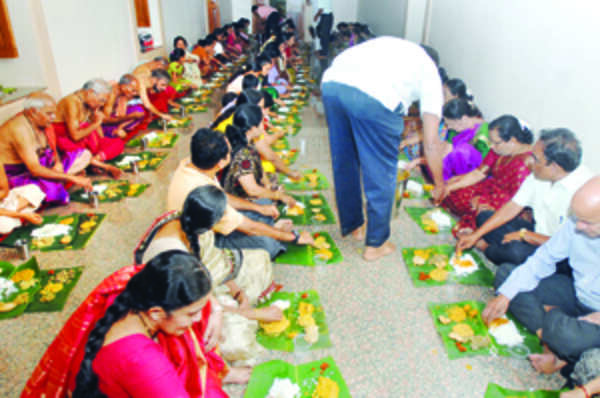
Also laid out in the traditional way is the kitchen floor—with a coat of cow dung. But most of the old equipment there is no longer in use, except the four chullas. The number of chullas go up three times on Anant Chaturdashi, when the family hosts its traditional dinner that is open to everyone, irrespective of religion or caste. The increase is not surprising given the fact that the serpentine queue outside starts from around 5pm and stretches right up to the Secretariat.
But ultimately, everyone gets a chance to savour the pure vegetarian delight. “We start cooking from morning for about 1,500 guests,” says Shankar. As is the tradition, food is served on plantain leaves and everyone sits on the floor to eat. On Anant Chaturdashi, the prayer room is decorated and an image of Lord Anant is taken out and placed in front of the sanctum sanctorum. At his feet is placed the famed right-handed conch, studded with pearls, gems and gold. “All temples have a left-handed conch. This one is unique because it is right-handed. It’s one of the prized possessions of our ancestors,” says Shankar.
Ganesh Chaturthi at the household sees a paper Ganesha idol brought out. “For years now, a new paper idol is supplied to us for every Chaturthi by a family from Reis Magos. We resorted to using a paper idol because in ancient times, idol worship was prohibited. A paper idol could be hidden easily in case of a raid,” says Shankar.
During Diwali, the variety of fovs that the family makes, are a craze. “We make different kinds of fovs. This time, a friend brought over two foreign tourists who wanted to experience Diwali in a heritage home. They liked the idea of sitting on the floor and eating,” says Shankar.
Apart from celebrations, the Mhamai Kamat house is famous for another reason—the rosewood and ebony furniture which you will see if you climb up the wooden staircase to the first floor.
But as is the case with most old houses, this structure also comes with its share of problems. “Maintenance is difficult but we choose to pump in the money ourselves,” says Shankar, adding that he received proposals from different agencies, including the state tourism department, for its maintenance. “We said no. Once you accept money from someone, you are under their control,” he says, leafing through the report of a research project on the house some students had carried out. And then he walks away, nodding to and greeting people who have come visiting.
End of Article
FOLLOW US ON SOCIAL MEDIA





Hot Picks
TOP TRENDING
Trending Stories
In City
Entire Website
- 'We were treated like slaves, made to work for 15 hours a day': Tricked into Ukraine war, 3 from Karnataka return home
- 'My father was on the flight': Jaishankar opens up about 1984 Air India hijack
- Airtel CEO Gopal Vittal sends letter to Reliance Jio, Vodafone-Idea, Tata Tele and BSNL CEOs; here's what he said
- Prince Harry to celebrate 40th birthday away from Meghan Markle
- Haitian immigrant pet-eating row: Ohio woman accused of eating cat is US citizen, video is not from Springfield
- Kejriwal out of jail; 'CBI arrest only to frustrate ED case bail': SC judge
- Donald Trump reveals what Laura Loomer is to his campaign: 'I don't control her'
- Hamster Kombat Daily Cipher Codes and Combo Cards for September 14, 2024: Unlock up to 1 million coins
- Laura Loomer's photo with Donald Trump viral. People ask where's Melania, where's wedding ring
- Garena Free Fire MAX redeem codes for September 13: Win in-game goodies and rewards
- Will Mamata's surprise visit to doctors' protest site pay off? Crucial meeting at CM's residence
- 'Nafrat ki dukaan pe ...': PM Modi attacks Congress over 'brutality' in US
- 'I was molested in ambulance in which my husband was fighting for life'
- Blast in central Kolkata leaves 1 person injured, area cordoned off
- Trump defends 'loony' Laura Loomer amid MAGA meltdown
- 'This plane is going down': California man threatens to kill everyone on plane
- Hum do hamare chaar: Why is south India junking population control?
- Bengaluru woman sparks controversy with comments about Swiggy delivery executive
- 'Rohit didn't practice as hard as Sachin': Rhodes
- No party more dishonest and deceiving than Congress: PM Modi in Haryana

Popular Categories
Hot on the Web
Top Trends
Trending Topics
World Largest HorseSector 36 ReviewGreen Apple BenefitsPriyanka Chopra TattooKottukkaali OTT ReleaseNarendra ModiGhaziabad Juice SellerHair LossSudha MurtyMalayalam ProducersIndia's Best Dancer 4Simi GarewalDilli BabuIndian National ParksLaung BenefitsVikas SethiApple iPhone 16Donald TrumpAadhar Card UpdateWordle Answer
Living and entertainment
Latest News
Kaun Banega Crorepati 16: Can you guess the answer for this Rs 3,20,000 question on Navy, which contestant Naman Jain incorrectly answered?Edible oil import duty hiked by 20%'Calling all Swifties for Trump': Donald's new campaign merch imitates Eras Tour shirtsWWE Hall of Famer Watches 15 Hours Of Wrestling Each WeekDallas Cowboys Set to Defend AT&T Stadium in Week 2 Clash with New Orleans SaintsTovino on training for Kalaripayattu in ‘ARM’: I practiced every single day, even if I had a hectic day on set8 animals that reproduce without matingDelhi Police Files FIR for Firecracker Celebration Outside CM Kejriwal's ResidenceThrowback: When Alia Bhatt responded to insecurity questions about Ranbir Kapoor, shut down gossipIndia's T20I captain Suryakumar Yadav turns 34: A glimpse into his stellar T20 careerThe 3 Strongest Zodiac Signs: Powerhouses of the Zodiac Wheel'Forgive me, I don't belong ...' : Tamil Nadu hotelier's apology to FM Nirmala Sitharaman over GST remark triggers political rowRakul Preet Singh reveals Bollywood stylists charge from Rs 15000 to Rs 1 lakh for one event, one outfit: 'Living in Mumbai requires a lot of PR'September 14, 2024: Flying creatures and how their wings workThrashed for 'molesting' kid on train, rail staffer diesKejriwal walks out of jail, says morale is up by 100 timesDhruv Kapila's health setback shatters Indian pair's Vietnam Open semifinal hopesFormer Titans Cheerleader Danielle Sekelsky Begins WWE NXT Training
Copyright © 2024 Bennett, Coleman & Co. Ltd. All rights reserved. For reprint rights: Times Syndication Service